


In the food processing industry, liquid nitrogen freezing technology is widely used for durian, seafood, meat, bakery products, fruits, and vegetables. Its rapid freezing capability helps minimize ice crystal formation and reduce damage to food structure, helping preserve the original quality, texture, and freshness of food products.
As food manufacturers place greater emphasis on product quality, production efficiency, and standardized processing, more businesses are considering investing in liquid nitrogen freezing equipment. However, one common question arises during the purchasing process: Should you choose a Liquid Nitrogen Cabinet Freezer or a Liquid Nitrogen Tunnel Freezer?
Although both types of equipment use liquid nitrogen as a cryogenic cooling medium, they differ significantly in structural design, production methods, processing capacity, and suitable applications. Choosing the wrong equipment may result in unnecessary investment and affect long-term production efficiency and operating costs.
In this article, we will compare these two types of liquid nitrogen freezers in terms of operating principles, production capacity, applications, and investment costs to help food manufacturers select the right freezing solution for their businesses.
A liquid nitrogen cabinet freezer is a batch-type freezing machine with an enclosed cabinet structure. During operation, food products are placed on trays, racks, or specially designed trolleys before being loaded into the freezing chamber.
The equipment uses liquid nitrogen spraying and low-temperature nitrogen gas circulation to rapidly create a low-temperature environment inside the chamber, allowing food products to be frozen efficiently.
Modern liquid nitrogen cabinet freezers are generally equipped with PLC automatic control systems, touchscreen interfaces, temperature monitoring, and liquid nitrogen injection control systems. Some models also support independent operation of multiple cabinets, allowing operators to adjust freezing parameters according to different product requirements.
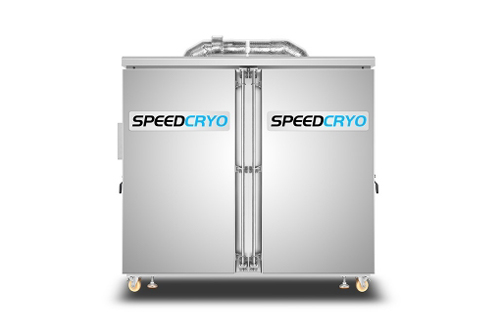
Key features of liquid nitrogen cabinet freezers include:
Batch production: Processes a specified quantity of food in each freezing cycle.
High product flexibility: Suitable for different food sizes, shapes, and product types.
Flexible operation: Freezing times and processing parameters can be adjusted for different products.
Compact structure: Generally requires less installation space than a tunnel freezer.
Suitable for small-batch production: Ideal for businesses handling multiple products or irregular orders.
For durian processors, small and medium-sized seafood manufacturers, and food factories that frequently change product types, a liquid nitrogen cabinet freezer offers greater production flexibility.
A liquid nitrogen tunnel freezer is a continuous freezing system mainly consisting of an insulated tunnel, conveyor belt, liquid nitrogen spraying system, low-temperature circulation fans, and an automatic control system.
Food products are continuously transported through the tunnel by a conveyor belt. During transportation, they exchange heat with the extremely cold nitrogen gas and gradually reach the required freezing temperature.
Unlike a cabinet freezer, a tunnel freezer does not need to stop after each batch for loading and unloading. As long as raw materials are continuously supplied, the equipment can maintain continuous operation.
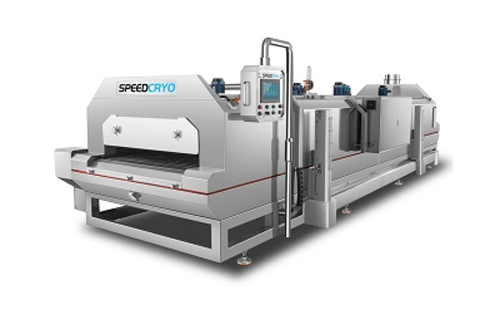
Key features of liquid nitrogen tunnel freezers include:
Continuous production: Reduces batch loading, unloading, and waiting time.
High processing capacity: Suitable for large-volume food processing.
Higher automation potential: Can be integrated with upstream processing and downstream packaging lines.
Adjustable freezing parameters: Freezing conditions can be controlled by adjusting conveyor speed and liquid nitrogen injection.
Ideal for standardized production: Particularly suitable for products with relatively consistent specifications and stable production schedules.
For large seafood processors, meat processing plants, and manufacturers requiring continuous high-volume production, a liquid nitrogen tunnel freezer is often a more suitable option.
The biggest difference between these two types of equipment is their production method: cabinet freezers operate in batches, while tunnel freezers provide continuous freezing.
| Comparison | Liquid Nitrogen Cabinet Freezer | Liquid Nitrogen Tunnel Freezer |
| Production method | Batch production | Continuous production |
| Loading method | Trays, racks, or trolleys | Automatic conveyor belt |
| Product changeover | More flexible | Requires conveyor and process adjustments |
| Production capacity | Small to medium-scale production | Medium to large-scale continuous production |
| Automation | Automatic control available | Easier to integrate into automated production lines |
| Floor space | Relatively compact | Requires space for the tunnel and conveyor system |
| Labor requirements | Some manual loading and unloading | Reduced manual handling |
| Investment cost | Generally lower | Generally higher |
Please note that this comparison is based on typical equipment configurations and is not an absolute standard. Actual equipment prices and processing capacities depend on machine specifications, configurations, product characteristics, and processing requirements.
A liquid nitrogen cabinet freezer may be the better choice if your business has the following production requirements.
1. You Process Multiple Types of Food Products
A food processing factory may handle durian pulp, seafood, beef, chicken, and bakery products at the same time. Different products often require different freezing times and processing parameters.
A cabinet freezer allows operators to adjust freezing programs according to individual product characteristics, making it easier to manage multiple product types within the same facility.
2. Your Daily Processing Volume Is Limited
Not every food manufacturer needs to process hundreds or even thousands of kilograms of food continuously every hour.
If your daily processing volume is only a few hundred kilograms, or production is arranged according to individual customer orders, a liquid nitrogen cabinet freezer is often a more practical choice. It can help avoid unnecessary equipment investment.
3. Your Factory Has Limited Floor Space
With its enclosed cabinet structure, a liquid nitrogen cabinet freezer does not require a long conveyor system. It is suitable for factories with limited available space or businesses looking to add a quick-freezing process to an existing production facility.
4. You Are Introducing Liquid Nitrogen Freezing Technology for the First Time
For businesses that are new to cryogenic freezing, starting with a suitable cabinet freezer can be a practical approach.
By monitoring actual freezing performance, liquid nitrogen consumption, and operating costs, manufacturers can better understand the technology before expanding production capacity as their business grows.
Typical applications include:
Batch freezing of durian pulp and whole durians.
Freezing shrimp, fish fillets, and other seafood products.
Processing beef, chicken, and meat products.
Freezing bread, cakes, dough, and other bakery products.
Product development and small-scale food production involving multiple product types.
If your business has stable orders and requires continuous, high-volume production, a liquid nitrogen tunnel freezer is generally worth considering.
1. Your Required Processing Capacity Is High
For example, if your factory needs to process 500 kg, 800 kg, or even more than 1,000 kg of food per hour, batch-type equipment may require frequent loading and unloading, increasing labor requirements and potentially affecting overall production efficiency.
A liquid nitrogen tunnel freezer uses a continuous conveyor system to transport products through the freezing chamber. This allows the freezing process to work more efficiently alongside upstream processing and downstream packaging operations.
2. Your Products Have Relatively Consistent Specifications
Tunnel freezers are particularly suitable for products with relatively consistent dimensions, weights, and processing requirements.
Typical examples include shrimp, fish fillets, meat portions, diced fruits, and prepared food products.
By adjusting conveyor speed, liquid nitrogen injection rates, and operating parameters, manufacturers can establish a consistent freezing process.
3. You Want to Improve Production Automation
A liquid nitrogen tunnel freezer can automatically handle product feeding, freezing, and discharge. This reduces manual handling and repetitive operations while making it easier to integrate the equipment with washing, cutting, sorting, weighing, and packaging systems.
4. Your Business Has Stable, Large-Volume Orders
For large food exporters, production efficiency, product quality, and batch consistency are particularly important.
A continuous liquid nitrogen tunnel freezer is better suited to large-scale, standardized production where stable processing capacity is required.
In actual projects, equipment selection should never be based solely on hourly processing capacity. Even if two factories have the same production target, their equipment requirements may differ significantly due to variations in product characteristics and freezing conditions.
The following five factors should be carefully evaluated.
1. Product Type and Dimensions
Different food products have different thicknesses, weights, moisture contents, and internal heat distributions.
For example, whole durians and durian pulp have significantly different freezing requirements.
Before selecting equipment, manufacturers should provide product dimensions, individual product weights, initial temperatures, and loading arrangements.
2. Actual Processing Capacity
Liquid nitrogen cabinet freezers are generally rated in kg/batch. Their capacity evaluation should consider the loading quantity per batch, freezing time, loading and unloading time, and the number of production cycles per day.
Liquid nitrogen tunnel freezers are generally rated in kg/h. Their actual processing capacity depends on conveyor width, product loading density, conveyor speed, and required freezing time.
3. Final Freezing Temperature
Product surface temperature and core temperature are not the same.
During equipment design, it is important to specify the required final core temperature, such as -18°C, together with the maximum product thickness and allowable freezing time.
These parameters directly affect liquid nitrogen injection rates, fan configurations, and equipment dimensions.
4. Liquid Nitrogen Consumption
Liquid nitrogen purchasing costs are an important part of long-term operating expenses.
Actual consumption depends on several factors, including initial product temperature, moisture content, product dimensions, target core temperature, equipment insulation performance, and liquid nitrogen injection control.
Therefore, manufacturers should evaluate liquid nitrogen consumption based on actual product and processing parameters rather than relying solely on equipment models or theoretical figures.
5. Factory Layout and Supporting Facilities
Before installation, manufacturers should confirm the liquid nitrogen storage tank, supply pipeline, electrical power requirements, installation space, ventilation and exhaust systems, and oxygen monitoring facilities.
It is particularly important to note that vaporized nitrogen can displace oxygen in the surrounding air. Proper ventilation, exhaust systems, and oxygen monitoring are essential to reduce the risk of oxygen deficiency.
Neither type of equipment offers a universally higher return on investment. The better choice depends on how well the equipment matches the manufacturer's production requirements.
A liquid nitrogen cabinet freezer offers a compact structure and flexible operation, making it suitable for multi-product and small-batch production. Businesses can also increase their processing capacity gradually by adding more cabinets as orders grow.
A liquid nitrogen tunnel freezer is more suitable for businesses with stable orders and higher production volumes. Continuous conveying reduces manual loading, unloading, and waiting time, helping improve overall production efficiency.
However, equipment purchasing decisions should not be based on the initial purchase price alone. Businesses should also evaluate:
Equipment purchase and installation costs.
Liquid nitrogen purchasing and transportation costs.
Labor and routine maintenance expenses.
Freezing cost per kilogram of product.
Equipment utilization rate and actual processing capacity.
Product losses and the economic value of improved product quality.
Only by considering both initial investment and long-term operating expenses can manufacturers make a more accurate assessment of the equipment's return on investment.
Guangzhou Speed Refrigeration Equipment Co., Ltd. (SPEEDCRYO) is a professional manufacturer of liquid nitrogen freezing equipment, specializing in cryogenic freezing machinery and food cold chain solutions. With more than 10 years of industry experience, we provide equipment solutions for food processing businesses with different production requirements.
Our equipment range includes:
Liquid Nitrogen Cabinet Freezers: Suitable for batch production, multiple product types, and flexible freezing processes.
Liquid Nitrogen Tunnel Freezers: Designed for continuous, high-volume production, with conveyor systems customized according to production capacity and product requirements.
Multi-Cabinet Liquid Nitrogen Freezing Systems: Suitable for businesses that require higher batch processing capacity while maintaining independent production management for different batches.
Depending on project requirements, our equipment can be configured with food-grade SUS304 stainless steel product-contact surfaces, PLC automatic control systems, touchscreen interfaces, liquid nitrogen injection control, and safety alarm systems.
SPEEDCRYO operates a production facility covering approximately 30,000 square meters, maintains an ISO 9001 quality management system, and has developed more than 100 patented technologies. Our products have been exported to more than 20 countries and regions worldwide.
In addition to standard equipment, we provide customized equipment selection and technical solutions based on product characteristics, target processing capacity, freezing requirements, and factory layout.
Liquid nitrogen cabinet freezers and tunnel freezers each have their own advantages. Neither type is suitable for every food processing business.
If your factory mainly handles multiple product types, small batches, and intermittent production, a liquid nitrogen cabinet freezer generally offers greater flexibility.
If your business has stable, high-volume orders and requires continuous production with a higher level of automation, a liquid nitrogen tunnel freezer may be the better choice.
Before purchasing equipment, clearly define your product type, required processing capacity, initial product temperature, target core temperature, and freezing time. These details will help the equipment manufacturer recommend a suitable solution.
Looking for a liquid nitrogen cabinet freezer or tunnel freezer for your food processing facility? Contact SPEEDCRYO today.
Send us your product photos, product dimensions, target processing capacity, and freezing requirements. Our team will evaluate your production needs and recommend suitable equipment models and liquid nitrogen freezing solutions for your business.
SPEEDCRYO – Your Professional Partner in Liquid Nitrogen Freezing Technology.
