


With the many advantages of liquid nitrogen freezing technology, many durian processors have the same question:
There is no one-size-fits-all answer. Every company has different production volumes, target markets, financial resources, and growth plans. This article provides a practical decision-making framework from several key perspectives to help food processors evaluate whether liquid nitrogen freezing is the right investment for their business.
The core value of liquid nitrogen freezing technology lies in product quality, brand differentiation, and access to higher-value markets.
Therefore, the first step is to understand your company's strategic positioning.
✅ Targeting premium markets: Planning to supply premium supermarkets, high-end e-commerce channels, or quality-sensitive export markets such as Japan, South Korea, and the Middle East.
✅ Seeking brand premium: Looking to differentiate the brand, reduce dependence on price competition, and potentially achieve a higher selling price through improved product quality and positioning.
✅ Prioritizing product quality: Using a "fresh-like" eating experience as a key selling point and aiming to preserve the original texture, flavor, and appearance as much as possible.
✅ Need for flexible production capacity: Wanting to adjust freezing capacity according to order volume rather than being constrained by the fixed capacity of a conventional freezing room.
✅ Limited or unstable power supply: Operating in an area where electricity availability or power capacity is limited, making a lower-power-dependent freezing solution attractive.
✅ Export-oriented: Supplying markets with strict food quality requirements and placing greater emphasis on product consistency, hygiene, and quality preservation.
✅ Small- or medium-scale entry: Processing approximately 100–1,000 tons per year and looking for a relatively accessible way to introduce cryogenic freezing technology.
❌ Purely volume-driven, price-sensitive businesses: Products are mainly sold through wholesale channels where customers are highly price-sensitive and there is little willingness to pay for differences in quality.
❌ Limited access to liquid nitrogen: Local liquid nitrogen suppliers are scarce, transportation costs are high, or supply reliability cannot be guaranteed.
The required investment in a liquid nitrogen freezer is closely related to your production volume and batch size.
Liquid nitrogen cabinet freezers can generally be selected according to processing capacity and cabinet dimensions.
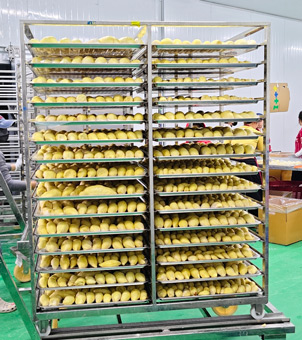
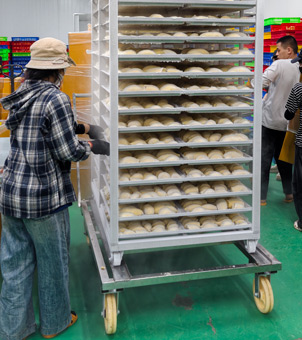
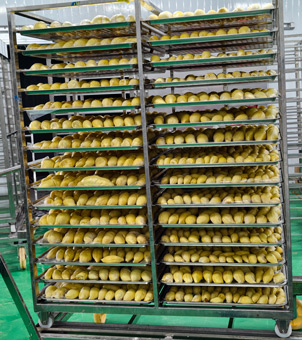
The image above shows the internal tray rack structure of a liquid nitrogen freezer. The multi-level design makes efficient use of the cabinet space. Businesses can select different rack configurations and tray sizes according to their batch capacity requirements.
A sound investment decision should be based on a clear financial assessment.
The following provides a simplified framework for evaluating the potential return on investment.
Revenue from product premium
= Annual production × Additional selling price per unit
Revenue from improved yield
= Annual production × Reduction in product loss × Raw material cost
Revenue from reduced defect rate
= Annual production × Reduction in defect rate × Product selling price
Additional order profit from flexible production
= Profit from additional orders made possible by flexible freezing capacity
Liquid nitrogen consumption cost
= Annual production × Liquid nitrogen consumption per unit × Liquid nitrogen price
Simple ROI Payback Calculation
Payback Period = Initial Investment ÷ (Annual Incremental Revenue − Annual Incremental Operating Costs)
For an actual investment decision, companies should replace these assumptions with their own production volume, product selling price, raw material costs, liquid nitrogen consumption, and local energy costs.
4. Evaluate Your Local Liquid Nitrogen Supply
Liquid nitrogen supply is one of the key factors affecting the long-term operation of a cryogenic freezing system.
Before investing, companies should conduct a detailed assessment of the local supply chain.
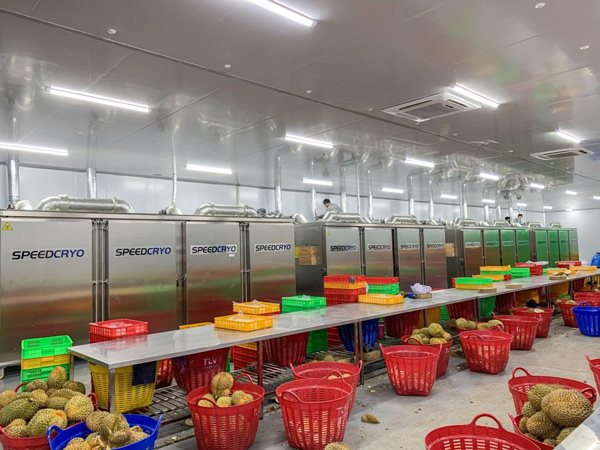
The image above shows a liquid nitrogen freezer operating in a factory environment. Before investing, companies should carefully evaluate available space, electrical conditions, ventilation and exhaust requirements, and the local liquid nitrogen supply.
A liquid nitrogen freezer is a technology-intensive investment. Choosing a reliable equipment manufacturer and technical partner is therefore important.
Consider the following questions:
For companies with limited capital or those that prefer to minimize investment risk, a phased investment strategy can be considered.
Before making a final investment decision, companies can use the following checklist for a preliminary self-assessment:
The more "Yes" answers you have, the stronger the case for conducting a detailed feasibility study. However, the final decision should be based on actual production volume, local liquid nitrogen prices, product margins, market demand, and the expected utilization rate of the equipment.
The durian industry is moving from a focus on volume and price toward greater emphasis on quality, differentiation, and added value.
For processors targeting premium markets, developing differentiated products, or seeking more flexible production capacity, liquid nitrogen freezing can be considered as part of a broader production and market strategy.
A liquid nitrogen freezer is more than a piece of processing equipment. It can become part of a company's strategy for improving product quality and developing higher-value products.
The key is to choose the right technology, the right capacity, and the right technical partner based on your actual production requirements and market opportunities.
