


Food safety is one of the most important requirements in the food industry. For durian, which has a high water and sugar content, microbial control is especially important during processing.
Freezing does not kill all microorganisms. However, the faster a food product passes through the temperature range where microorganisms can grow, the less time they have to grow before freezing.
This is one of the main advantages of liquid nitrogen freezing technology.
Microbial growth is closely related to temperature. Different types of microorganisms prefer different temperature ranges.
This means that cooling food from room temperature to freezing temperature is not simply a matter of making the product cold. The time spent during cooling also matters.
With a traditional cold room or slower freezing system, durian may take a long time to reach its target core temperature. During this period, microorganisms may still be active.
Some foodborne pathogens, such as **Listeria monocytogenes**, are also able to survive and grow at low temperatures. Therefore, good temperature control and good hygiene are both important during food processing.
Liquid nitrogen has a temperature of approximately **-196°C**. When it is used in a properly designed freezing cabinet, it can remove heat from food very quickly.
For durian, a typical freezing cycle may bring the product from room temperature to below **-18°C** within a relatively short period, depending on the product size, loading method, starting temperature and equipment design.
This rapid cooling provides three important benefits.
The faster the product passes through temperatures where microorganisms can grow, the shorter the time available for microbial growth.
Liquid nitrogen freezing can greatly reduce this cooling period compared with slower freezing methods.
The goal is not to sterilize the durian. Instead, the goal is to **freeze the product quickly and reduce the time available for microbial growth**.
Once the product reaches sufficiently low temperatures, the growth and metabolic activity of most microorganisms become very limited.
However, it is important to understand that freezing does not normally destroy all microorganisms. Many microorganisms can survive in a frozen state and may become active again after thawing.
For this reason, rapid freezing should always be combined with good raw material control, clean processing conditions, proper packaging and a reliable cold chain.
Another important advantage is temperature uniformity.
A well-designed liquid nitrogen freezer uses a controlled nitrogen injection and air circulation system to distribute cold air inside the chamber. This helps the product freeze more evenly.
For durian meat, this is particularly important because the outside of the product may freeze before the center.
If the surface is already frozen while the core is still relatively warm, the product may spend more time in an unfavorable temperature range.
Good airflow and proper product loading help reduce this difference and improve the consistency of the freezing process.
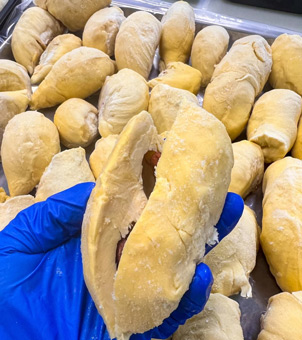
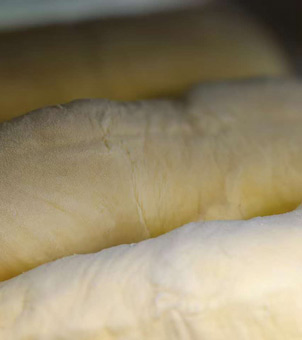
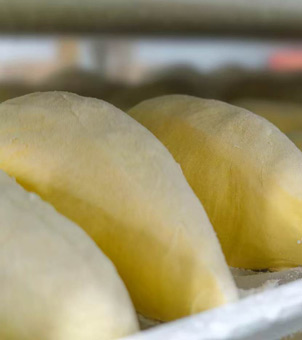
*The image above shows frozen durian products stored in a cold room after liquid nitrogen freezing. Rapid and even freezing helps the products reach the required core temperature before cold storage.*
For durian processors targeting international markets, food safety is an important part of export preparation.
Different markets have different regulations for frozen fruit, including requirements for microorganisms, pesticide residues, heavy metals, labeling and food processing controls.
For example, companies exporting to markets such as the **European Union, the United States, Japan and South Korea** need to meet the food safety requirements of the destination market.
In many cases, buyers and importers may also request:
It is important to point out that **a fast freezer alone cannot guarantee that a product will pass an export inspection**.
The final food safety result depends on the whole production process, including raw materials, cleaning, handling, packaging, freezing, storage and transportation.
However, a fast and well-controlled freezing process can be an important part of this system.
HACCP, or **Hazard Analysis and Critical Control Points**, is widely used in the food industry to identify and control food safety risks.
Freezing may be an important control step in a food production process, depending on the product and the company's HACCP plan.
Liquid nitrogen freezers can support this system in several ways.
Liquid nitrogen freezing provides a very fast cooling response. With automatic temperature and time control, operators can set clear freezing conditions for each product.
This makes the process easier to standardize from batch to batch.
A short and clearly defined freezing cycle makes it easier for operators to monitor production.
For example, the company can define:
These parameters can then be checked for every batch.
Modern liquid nitrogen freezing cabinets can be equipped with PLC control systems and touch screens.
Important operating data, such as temperature and freezing time, can be recorded and used for production management and traceability.
This can be useful when customers ask for production records or when the company needs to investigate a quality problem.
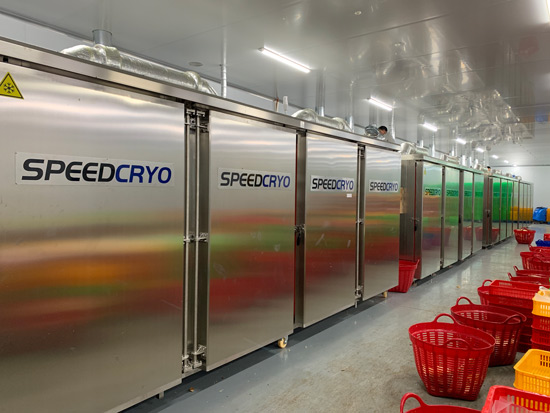
*Multiple liquid nitrogen freezing cabinets can be used in a food processing plant. Stainless steel construction, automatic control and an enclosed freezing chamber can help support modern food production and hygiene requirements.*
For frozen durian, food safety is not only a technical issue. It also affects the customer's confidence in the product.
A company that wants to build a high-quality frozen durian brand can use its production and quality control system to show customers how the product is handled.
For example, companies can:
Show the freezing process clearly
Explain how the product is quickly frozen and how the target core temperature is controlled.
Provide third-party test reports
Regular microbiological and chemical testing can provide objective evidence of product quality.
Improve production transparency
Customers and business partners can be shown the processing area, freezing equipment and cold storage conditions where appropriate.
Keep complete production records
Batch numbers, freezing parameters, test results and storage records can help improve traceability.
These measures are more convincing than simply saying that a product is "safe" or "high quality."
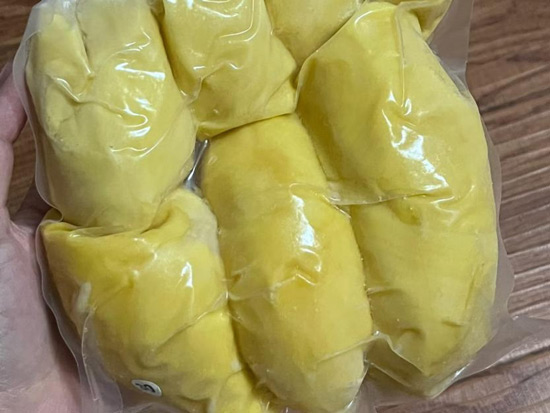
*Frozen durian can be packed in sealed or vacuum packaging after processing. Proper packaging, rapid freezing and a continuous cold chain work together to protect product quality and food safety.*
For durian processors, liquid nitrogen freezing offers an important technical advantage: **very fast heat removal**.
It can shorten the time that durian spends in temperatures where microorganisms may grow. It can also help improve freezing uniformity and product consistency.
But freezing should never be treated as a replacement for good hygiene or food safety management.
A complete food safety system should include:
For companies exporting frozen durian, these factors work together to determine the final product quality.
Liquid nitrogen freezing is not a substitute for food safety management. It is a powerful tool that can become an important part of it.
By combining rapid freezing technology with proper hygiene, packaging, testing and cold-chain management, durian processors can better protect product quality and build a more reliable supply of export-quality frozen durian.
