


In an era that prioritizes efficiency and quality, the concept of "freezing" has long transcended mere preservation, becoming a critical battle that determines the very life and flavor of food ingredients. When you purchase a box of individually frozen, fresh-tasting shrimp from the supermarket, or enjoy crispy-on-the-outside, juicy-on-the-inside french fries at a restaurant, behind these experiences lies a technological duel centered on "speed" and "individuality." Today, we will delve into a cornerstone technology of the modern freezing industry—IQF (Individual Quick Freezing)—and reveal how its pinnacle implementation, Liquid Nitrogen IQF Flash Freezing, harnesses the extreme cold of -196°C to lock in the independent freshness and deliciousness of every single food item.
Traditional block freezing involves stacking large quantities of food together, resulting in a solid, frozen mass. This method brings several disadvantages: the entire block must be thawed for use, with repeated freezing and thawing degrading quality; products stick together, compromising their appearance; most critically, the slow freezing process leads to the formation of large ice crystals within cells, severely damaging their structure.
The concept of IQF (Individual Quick Freezing) was born to address these issues. It has two core objectives:
1. "Individual": Ensures that each piece of food—whether a strawberry, a fillet of fish, or a shrimp—remains separate and non-clumping after freezing, facilitating portioning, storage, and on-demand use.
2. "Quick Freezing": Achieves the fastest possible rate of lowering the food's core temperature through the critical "-1°C to -5°C" zone, known as the "maximum ice crystal formation zone." This rapid transition promotes the formation of tiny, uniform ice crystals both inside and outside cells, maximizing the protection of cellular integrity.
Liquid nitrogen freezing stands as one of the ultimate technological pathways to achieve the highest standard and efficiency of IQF.
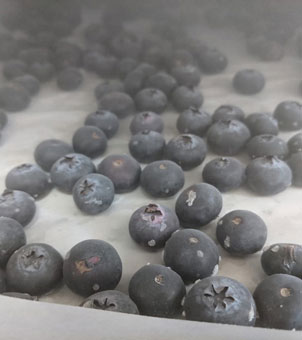
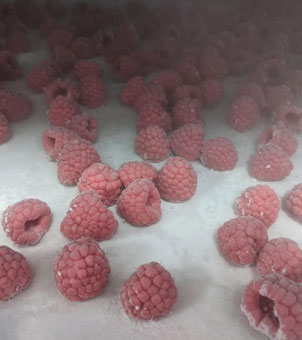
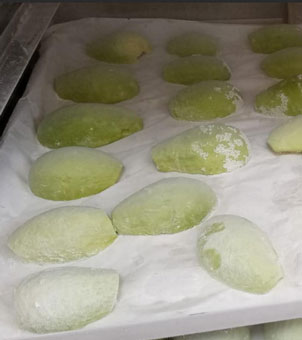
Liquid nitrogen is not a synthetic chemical but simply nitrogen gas (which constitutes 78% of air) in its liquefied form. With a boiling point as low as -196°C, it violently boils and vaporizes upon contact with objects at ambient pressure and temperature. This phase change absorbs a tremendous amount of heat (latent heat of vaporization), generating unparalleled instantaneous cooling power.
This property perfectly aligns with the demands of IQF:
● Extremely High Heat Transfer Rate: The initial temperature difference of -196°C creates an incredibly steep thermal gradient, "pulling" heat away almost instantaneously.
● Dry Freezing Environment: Once vaporized, liquid nitrogen becomes pure, dry nitrogen gas. This prevents frost and ice splatter from moisture on the food surface, a key factor in maintaining product "individuality" and preventing clumping.
● Inert and Safe: Nitrogen is an inert gas. It does not react with food, causes no oxidation or off-flavors, and acts solely as a pure cooling medium.
A liquid nitrogen IQF system is a precise engineering feat. Its principles can be understood on two levels: macroscopic process and microscopic physics.
Macroscopic Process: An Efficient Ultra-Cold Tunnel
Food items are evenly distributed in a single layer on a conveyor belt or vibrating screen, entering the liquid nitrogen freezing tunnel. Inside, specially designed nozzles atomize the liquid nitrogen into a fine, low-temperature mist. This mist is thoroughly mixed with an air stream guided by powerful fans, forming a uniform, ultra-low-temperature, high-velocity air flow (reaching temperatures between -80°C and -120°C). As the food travels rapidly through this airflow, it undergoes three stages:
1. Crust Freezing Phase: The product's surface temperature plummets below freezing within seconds, forming a thin, hard frozen crust. This crust locks in internal moisture and flavor compounds, provides initial shape setting, and prevents sticking.
2. Deep Freezing Phase: The intense cold penetrates rapidly into the food's interior via conduction. The core temperature drops precipitously, swiftly crossing the maximum ice crystal formation zone.
3. Equilibration & Stabilization Phase: The product's core temperature reaches the set target (typically -18°C or lower), and the temperature throughout the product stabilizes uniformly.
The entire process is typically completed within a few minutes to just over ten minutes, making it several times more efficient than traditional mechanical air-blast IQF equipment.
Microscopic Physics: The "Gentle Revolution" in Ice Crystal Morphology
This is the core of liquid nitrogen IQF's value. Freezing rate is the most critical factor determining ice crystal size.
● Slow Freezing: Water outside the cells freezes first, forming ice nuclei. As the internal water remains unfrozen, the concentration of solutes outside the cells increases. This draws water out from inside the cells through osmosis, causing the existing external ice crystals to grow larger, forming large, sharp, needle-like ice crystals. These crystals puncture cell membranes and walls, causing permanent damage.
● Liquid Nitrogen Flash Freezing: The powerful cooling capacity extracts heat from the food with extreme speed. The water inside and outside the cells reaches its freezing point almost simultaneously, in situ. The water molecules have no time to migrate and aggregate. Instead, they instantly form a vast number of extremely small, fine ice crystals at countless locations simultaneously. These micro-crystals are distributed evenly inside and outside the cells, acting like a perfect supportive scaffold that causes no mechanical damage to the cell membranes.
Upon thawing, there is minimal cellular fluid (drip) loss. Texture, color, flavor, and nutritional components are preserved almost perfectly. This is the fundamental reason why premium seafood, berries, and prepared meal ingredients opt for liquid nitrogen IQF.
An advanced liquid nitrogen IQF system is far more than just spraying liquid nitrogen; it is a crystallization of fluid dynamics, thermodynamics, and intelligent control.
1. Precise Distribution System: Ensures products enter the freezing zone evenly and in a single layer—the foundation for achieving "individual," non-clumping results.
2. Efficient Atomization and Airflow Management: The liquid nitrogen must be fully atomized and mixed with the airflow to create a uniform low-temperature field, avoiding "freezing dead zones." Fan speed and direction require meticulous design to optimize heat exchange efficiency without blowing away lightweight products.
3. Precise Zoned Temperature Control: The tunnel is divided into different temperature zones along the conveyor path. The front section may be for crust freezing at extremely low temperatures; the middle and rear sections are for deep penetration and temperature equilibration. An intelligent control system dynamically adjusts the liquid nitrogen spray volume in each zone based on sensor feedback, optimizing energy consumption while guaranteeing quality.
4. Discharge Temperature Control: The final temperature of products exiting the tunnel must be precise and stable, ensuring deep freezing requirements are met and providing a safety margin for subsequent cold storage.
Based on the principles above, liquid nitrogen IQF technology demonstrates comprehensive competitive advantages:
● Unrivaled Quality: Ultrafast freezing minimizes cellular damage. Thawed products are closest to their fresh state, with exceptionally high juice retention, and unparalleled preservation of taste, appearance, and nutrition.
● Unmatched Speed: Freezing times are measured in minutes, dramatically boosting production efficiency. Ideal for continuous, large-scale production, especially for high-value, perishable products.
● Excellent Individuality (IQF Effect): The dry freezing environment and rapid surface setting enable products to achieve true non-clumping, non-sticking characteristics with excellent flowability.
● High Equipment Flexibility: Typically requires less floor space than mechanical freezers of comparable capacity. Systems are ready to use immediately, with no long pre-cooling periods, suiting multi-variety, batch production models.
● Production Scalability: Capacity increases are relatively straightforward, often achievable by extending the tunnel or increasing conveyor speed, whereas expanding mechanical refrigeration systems is far more complex.
IQF is a fundamental requirement in modern food processing, and liquid nitrogen technology is the "crown jewel" for achieving top-tier IQF results. It is more than just a freezing technique; it is a strategic choice for quality assurance, minimizing the erosion of food's flavor by time.
From premium ingredients in fine dining to convenient foods on the family table, and the booming sectors of prepared meals and cross-border e-commerce, the demand for "independent pieces, instantly locked in freshness" is growing exponentially. Understanding the principle and value of liquid nitrogen IQF means mastering a core competency for competing in the high-quality arena.
Choosing a scientifically designed, precisely controlled liquid nitrogen IQF freezing system empowers your products to define new standards for "freshness" and "convenience." In this competition where speed and quality are paramount, the most advanced technology remains your most reliable partner.
