


Many consumers have had this experience:
Some frozen foods remain tender, juicy, and almost indistinguishable from fresh products after thawing. Others, however, release large amounts of liquid, become soft and dry, lose their original texture, or even suffer noticeable flavor degradation.
Many food processors attribute these differences to raw material quality or product formulation. In reality, one of the most important factors determining the quality of frozen food is ice crystal size.
In food freezing science, there is a widely accepted principle: Food quality is not damaged by low temperature itself; it is damaged primarily by ice crystal formation and growth.
Therefore, an excellent freezing process is not simply about reducing the product temperature to -18°C or -20°C. The key is to minimize the time the food spends in the maximum ice crystal formation zone, thereby reducing the structural damage caused by large ice crystals.
This is one of the fundamental reasons why more and more food manufacturers are adopting Cryogenic IQF Freezing Technology.
Most foods contain approximately 60% to 90% water.
For example:
When food begins to freeze, its water gradually transforms into ice crystals.
If freezing is relatively slow, small ice crystals have more time to grow and aggregate, eventually forming larger ice crystals. These large ice crystals can rupture cell walls and cell membranes, causing irreversible damage to the internal structure of the food. This is why many traditionally frozen products experience significant drip loss, structural deterioration, and texture loss after thawing. In other words, the factor that truly affects frozen food quality is not simply the final temperature, but what happens during the ice crystal formation process.
Conventional mechanical freezing primarily relies on low-temperature air to transfer heat away from the product.
Because air has relatively low thermal conductivity, the center of the food cools relatively slowly.
For many food products, reducing the temperature from ambient conditions to the target freezing temperature can take tens of minutes or even longer.
During this process, the product spends a considerable amount of time passing through the critical temperature range around 0°C to -5°C.
This stage is commonly referred to as the:
The longer the food remains in this temperature range, the more opportunity ice crystals have to grow.
Large ice crystals can ultimately:
For croissants, large ice crystals can compromise the delicate layered structure between butter and dough. For seafood, they can lead to significant drip loss after thawing. For fruits and vegetables, they can result in softening, loss of crispness, and structural deterioration.
Therefore, while conventional mechanical freezing can effectively reduce product temperature, it may not provide the same level of quality preservation as an ultra-fast freezing process.
Cryogenic IQF Freezing Technology uses the ultra-low-temperature environment created by liquid nitrogen, which has a temperature of approximately -196°C.
When liquid nitrogen is introduced into the freezing chamber and comes into contact with the surrounding product environment, it rapidly vaporizes and absorbs a large amount of heat.
Due to the extremely high heat absorption capacity associated with liquid nitrogen vaporization, food can pass through the maximum ice crystal formation zone in a very short period of time.
The entire freezing process can often be completed within minutes, significantly reducing freezing time compared with conventional mechanical freezing.
Because the freezing rate is extremely rapid, the water inside the food tends to form a much larger number of smaller and more uniformly distributed ice crystals.
Smaller ice crystals cause substantially less physical damage to cellular structures, helping preserve the original structure and quality of the food.
For food processors, this can mean:
This is one of the key reasons why Liquid Nitrogen IQF Freezers can deliver significant quality advantages for high-value food products.
Compared with many conventional food products, croissants are particularly sensitive to freezing conditions.
This is because they contain three highly sensitive structural characteristics:
First, croissants have a laminated structure consisting of alternating layers of butter and dough.
Second, they may contain active yeast.
Third, they rely on a delicate and complex gluten network to achieve their final volume and texture.
If the freezing process is too slow, several problems can occur during cooling:
As a result, even though the croissant has been successfully frozen, the baked product may exhibit reduced lamination, insufficient volume, a less pronounced flaky structure, or a harder texture.
With Cryogenic IQF Freezing Technology, the product can be frozen rapidly, helping preserve its original laminated structure and providing more consistent baking performance after thawing.
For industrial bakery production, this can be particularly valuable when manufacturers need to maintain consistent product quality across large production volumes.
In the past, cryogenic freezing was often associated with high-value seafood products.
Today, as food quality requirements continue to increase, Liquid Nitrogen IQF in the Food Industry is being adopted across a much broader range of applications, including:
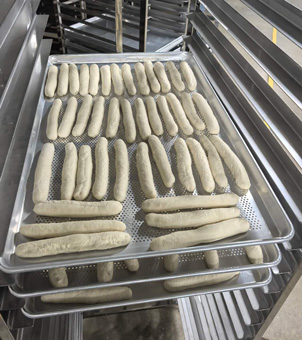
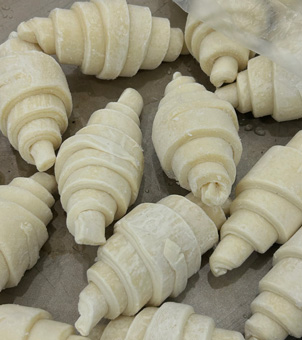
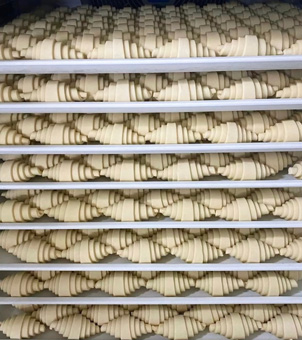
These industries share a common objective:
They are not simply looking for a way to freeze food. They want to preserve the fresh-like quality of the product after freezing, storage, transportation, and thawing.
As a result, cryogenic freezing is becoming an increasingly important technology for premium food processing applications.
Freezing technology is only one part of the equation. The equipment itself also has a significant impact on production efficiency and process consistency.
Modern Cryogenic Mini Freezers can use continuous conveyor-based systems and can be configured according to different product requirements, including:
This flexibility allows one freezing system to handle a wide variety of food products.
For central kitchens, multi-SKU food factories, bakeries, and manufacturers with fluctuating production volumes, this flexibility makes it easier to switch between different products without requiring long equipment pre-cooling periods.
As a result, manufacturers can improve production flexibility while optimizing operating costs.
Consumers are increasingly concerned about food quality, texture, freshness, and overall eating experience.
For food manufacturers, a high-quality frozen product can mean:
By contrast, if the freezing process causes excessive drip loss or structural damage, even high-quality raw materials may fail to deliver the desired eating experience.
Therefore, more food manufacturers are beginning to regard freezing technology as an important part of **food quality management**, rather than simply a low-temperature storage process.
From a food science perspective, the quality of frozen food is determined not simply by the final freezing temperature, but by **the freezing rate, ice crystal formation, and the resulting microstructure of the product**.
Cryogenic IQF Freezing Technology uses the ultra-low temperature of liquid nitrogen to rapidly freeze food, allowing products to pass through the maximum ice crystal formation zone in a much shorter period of time. This promotes the formation of smaller ice crystals, helps minimize cellular damage and drip loss, and preserves the original texture, appearance, and quality characteristics of the food.
Whether the product is a croissant, seafood, meat, fruit, vegetable, or prepared food, cryogenic freezing can provide food manufacturers with a powerful tool for achieving higher-quality frozen products and meeting the growing market demand for premium frozen foods.
As a professional manufacturer of cryogenic freezing equipment, SPEEDCRYO focuses on the development and manufacturing of advanced Liquid Nitrogen IQF Freezers and Cryogenic Mini Freezers, providing efficient, flexible, and reliable cryogenic freezing solutions for food processors worldwide.
Through continuous innovation in Cryogenic IQF Freezing Technology, SPEEDCRYO helps food manufacturers preserve product quality, improve production efficiency, reduce product losses, and strengthen their competitiveness in the global food market.
