


In the food processing industry, energy consumption typically accounts for a significant portion of operating costs. When it comes to freezing, the conventional perception is that freezing means high electricity consumption. Large compressors, long operating hours, and substantial refrigeration loads have shaped the industry's traditional understanding of freezing energy consumption.
However, liquid nitrogen freezers are challenging this conventional perception. According to actual operating data, a liquid nitrogen freezer operating for 10 hours per day can consume less than 50 kWh of electricity, equivalent to only about 8% of the electricity consumed by a conventional blast freezer for a single freezing cycle. This energy advantage not only translates into lower operating costs, but also creates new opportunities for applications in markets where electricity supply and infrastructure are limited.
To understand the energy-saving advantages of liquid nitrogen freezers, let's first break down the electricity consumption structure of a conventional blast freezer.
Refrigeration Unit
The refrigeration system is usually the largest electricity-consuming component. Conventional blast freezers rely on mechanical vapor-compression refrigeration systems and require high-power compressors to continuously maintain temperatures of approximately -35°C to -40°C.
A typical compressor may have a power rating of 30–50 kW, meaning it can consume approximately 30–50 kWh of electricity per hour when operating at full load.
Fan System
To maintain uniform temperatures throughout the freezing chamber, blast freezers are equipped with high-power circulation fans. These fans need to operate continuously during the freezing process and may consume approximately 5–10 kWh per hour, depending on the system configuration.
Auxiliary Equipment
Additional electrical loads come from lighting, defrost heaters, control systems, evaporator fans, and other auxiliary components. Although the power consumption of each individual component may be relatively small, their combined consumption can become significant over extended operating periods.
Overall Calculation
Based on the above configuration, a conventional blast freezer can consume approximately 50 kWh of electricity per hour under certain operating conditions. An 8–12-hour freezing cycle could therefore consume approximately 400–600 kWh.
If the system operates one full batch every day, monthly electricity consumption could reach approximately 12,000–18,000 kWh.
The energy consumption structure of a liquid nitrogen freezer is fundamentally different from that of a conventional mechanical refrigeration system.
Liquid Nitrogen Supply System
Liquid nitrogen is the primary source of refrigeration capacity. Its consumption is treated as a consumable operating cost rather than an electricity cost.
Liquid nitrogen is delivered from a cryogenic storage tank to the freezer through vacuum-insulated piping. The electrical energy required for the delivery system is relatively low compared with the power required to drive a large mechanical refrigeration system.
Control System
The control system includes temperature sensors, PLC controllers, a human-machine interface (HMI), and other electrical components. Its total power consumption is typically less than 1 kW.
Small Circulation Fans
The freezer may also be equipped with small circulation fans to promote more uniform distribution of vaporized nitrogen inside the chamber. These fans typically consume only around 1–2 kW, depending on the equipment configuration.
Overall Calculation
Under typical operating conditions, a liquid nitrogen freezer operating for 10 hours can consume less than 50 kWh of electricity.
In terms of electrical consumption alone, this is comparable to the daily electricity usage of a household air-conditioning system, yet it can support the operation of an industrial-grade freezing system.
The key difference is that the refrigeration load is primarily supplied by liquid nitrogen rather than by an electrically driven compressor.
The low electrical demand of liquid nitrogen freezers creates benefits that go beyond simple energy savings.
1. Suitable for Areas with Unstable Power Supply
In parts of Southeast Asia, Africa, and South America, particularly in developing food-processing regions and fruit-producing areas, unstable electricity supply can be a significant operational challenge.
Conventional blast freezers are highly dependent on stable electrical power. Voltage fluctuations or unexpected power outages can interrupt the freezing process and potentially compromise an entire batch of products.
Liquid nitrogen freezers, by contrast, have relatively low electrical requirements. The cryogenic storage system also provides a continuous supply of refrigerant, meaning that short-term power interruptions do not necessarily interrupt the availability of the cooling medium.
This makes liquid nitrogen freezing particularly attractive for processing facilities operating in regions where electrical infrastructure is limited or unreliable.
2. Lower Investment in Electrical Infrastructure
When building a new food-processing plant, a conventional blast freezing system may require a substantial electrical capacity.
This can increase investment in:
Because a liquid nitrogen freezer has a relatively low electrical load, the required electrical infrastructure can be significantly smaller, helping reduce the initial investment required for the facility.
3. Simpler Emergency Power Solutions
A conventional refrigeration system with large compressors may require a high-capacity diesel generator to maintain operation during a power outage.
For a liquid nitrogen freezer, the electrical load is much lower. Therefore, a smaller backup generator may be sufficient to maintain essential control and auxiliary systems.
This can reduce not only the initial investment in backup power equipment, but also its maintenance and fuel costs.
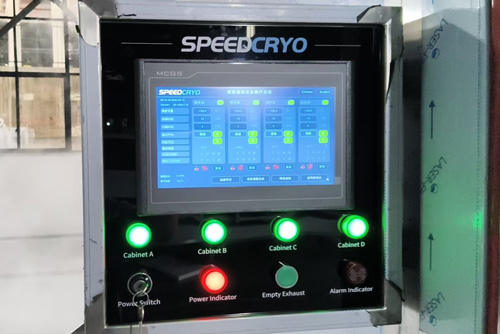
The image above shows the operating interface of a liquid nitrogen freezer. The intelligent control system is designed for straightforward operation while maintaining very low electrical power requirements, making the equipment suitable for food-processing environments with different power conditions.
Objectively speaking, the operating cost of a liquid nitrogen freezer is not zero.
Liquid nitrogen is a consumable and must be continuously supplied. In many applications, liquid nitrogen represents the primary operating expense of a cryogenic freezing system.
However, when evaluating the economics of the system, it is important to consider the total cost of ownership (TCO) rather than looking at electricity consumption alone.
Predictable Liquid Nitrogen Costs
Liquid nitrogen pricing varies according to location, production capacity, transportation distance, and supply contracts.
For food-processing companies with stable production volumes, long-term supply agreements with local nitrogen suppliers can help improve cost predictability.
Exposure to Electricity Price Fluctuations
Electricity represents a major long-term operating expense for mechanically refrigerated freezing systems.
As industrial electricity prices change over time, companies with high electrical loads become increasingly exposed to fluctuations in energy costs.
The relatively low electrical demand of liquid nitrogen freezers can reduce this exposure and provide greater flexibility when electricity prices rise.
Flexible Operation Creates Additional Savings
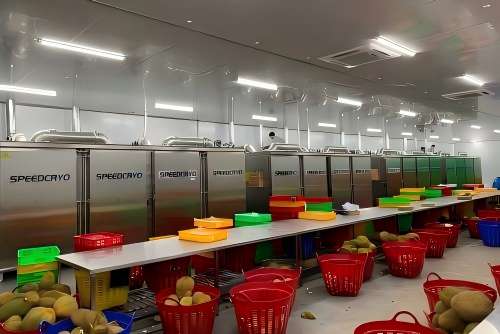
Another important advantage is operational flexibility.
Liquid nitrogen freezer cabinets can be operated independently according to actual production requirements. During peak production periods, multiple units can operate simultaneously. During low-demand periods, only the required number of cabinets needs to be switched on.
This differs from a large conventional freezing system, where operating the refrigeration plant may involve a relatively high fixed energy load regardless of whether the available freezing capacity is fully utilized.
For companies with variable production volumes, seasonal demand, or multiple product categories, this flexibility can have a significant impact on operating costs.
As ESG (Environmental, Social, and Governance) considerations become increasingly important, food manufacturers are paying greater attention to the environmental impact of their production processes.
The low electrical demand of liquid nitrogen freezing technology can contribute to a more energy-efficient manufacturing process.
Potential environmental advantages include:
After liquid nitrogen absorbs heat from the product and vaporizes, it becomes gaseous nitrogen and returns to the atmosphere. Nitrogen is already the primary component of Earth's atmosphere, and the freezing process does not directly release a greenhouse gas from the nitrogen itself.
However, the overall environmental impact should be evaluated based on the complete nitrogen supply chain, including nitrogen production, liquefaction, transportation, and the source of electricity used by the nitrogen plant.
For food-processing companies evaluating new freezing technology, the question should not simply be "How much electricity does the freezer consume?"
A more comprehensive question is:
"How much does the entire freezing system cost to build, operate, maintain, and scale over its service life?"
Liquid nitrogen freezing changes the traditional energy model of industrial freezing. Instead of relying primarily on electricity to drive a large mechanical refrigeration system, it uses liquid nitrogen as the primary cooling medium, while electricity is mainly required for controls, fans, sensors, and auxiliary systems.
This can result in exceptionally low electrical consumption.
For applications such as durian, seafood, meat, poultry, bakery products, prepared foods, and high-value frozen foods, especially in regions with limited electrical infrastructure or fluctuating production demand, a liquid nitrogen freezer can offer a compelling combination of rapid freezing, flexible operation, low electrical demand, and reduced infrastructure requirements.
For companies pursuing sustainable manufacturing, the value of a liquid nitrogen freezer is therefore not limited to saving electricity. It represents a different approach to designing the entire freezing process—one that separates freezing capacity from electrical power demand and provides manufacturers with greater flexibility in how they build and operate their cold-chain infrastructure.
