


In food freezing science, one principle has been universally recognized for decades: The size of ice crystals determines the quality of frozen food.
Although this statement sounds simple, it reflects fundamental principles of thermodynamics and food chemistry. For premium tropical fruits such as durian, which contain a high percentage of water, ice crystal morphology directly determines the final market value of the product. It is often the difference between an ordinary frozen commodity sold at a low price and a premium "fresh-frozen" product that commands significantly higher margins.
This article explores the fundamental differences between **liquid nitrogen blast freezers** and **conventional mechanical blast freezers** from the perspective of ice crystal science, explaining why freezing technology plays such a critical role in preserving the quality of frozen durian.
Freezing is far more complex than simply turning water into ice. It is a sophisticated phase-transition process involving three stages:
The characteristics of the resulting ice crystals are primarily governed by two factors:
Cooling Rate
Cooling rate refers to how quickly the temperature of the food decreases over time.
A rapid cooling rate prevents water molecules from migrating and organizing into large crystals. Instead, countless tiny ice nuclei form simultaneously.
A slow cooling rate allows water molecules to migrate toward existing crystals, resulting in fewer but much larger ice crystals.
Degree of Supercooling
Supercooling is the difference between the actual temperature of the product and its freezing point.
The greater the supercooling, the stronger the driving force for nucleation.
This means:
* More ice nuclei are formed.
* Individual ice crystals remain much smaller.
* Ice crystals are distributed more uniformly throughout the tissue.
A liquid nitrogen blast freezer takes full advantage of both extremely rapid cooling and deep supercooling, fundamentally changing how ice forms inside durian pulp.
Traditional blast freezers typically operate between **-18°C and -40°C**, using mechanical refrigeration and forced-air circulation to remove heat from the product. During this relatively slow freezing process, durian pulp experiences several unfavorable conditions.
Cooling fresh durian from approximately **25°C to -18°C** generally requires **8 to 12 hours**. More importantly, the product remains within the **maximum ice crystal formation zone (0°C to -5°C)** for approximately **2 to 3 hours**. This temperature range is critical because most water inside the fruit freezes during this period.
Because cooling occurs gradually, water has sufficient time to migrate outside the cells before freezing. Large extracellular ice crystals, often **50–100 μm** in diameter, begin to develop. These crystals frequently exhibit irregular dendritic (branch-like) structures that resemble tiny spears penetrating surrounding cells.
As these large crystals expand, they generate tremendous mechanical stress. The result is:
* Cell membrane rupture
* Cell wall collapse
* Permanent destruction of tissue structure
Once thawed, the damaged cells cannot recover their original shape. The fruit loses its natural texture and structural integrity.
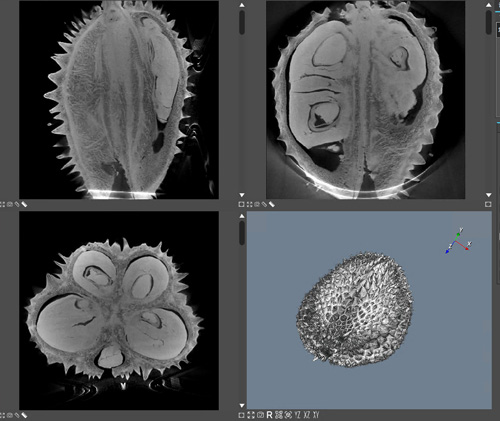
The X-ray CT image of a durian fruit clearly illustrates its intricate internal chamber structure. Large ice crystals formed during conventional freezing can destroy these delicate tissue compartments, leading to structural collapse after thawing.
Products frozen using traditional mechanical systems commonly exhibit:
* Significant drip loss during thawing
* Soft, mushy texture
* Broken fibers with a grainy mouthfeel
* Considerable loss of aroma compounds
* Noticeably weaker flavor
A liquid nitrogen blast freezer uses liquid nitrogen at **-196°C** as the refrigerant. Specialized spray nozzles rapidly expose the product to ultra-low temperatures, creating an entirely different freezing mechanism.
Durian pulp typically passes through the maximum ice crystal formation zone in only **35–45 minutes**. Instead of remaining between **0°C and -5°C** for several hours, the product moves through this critical range within minutes.
The extremely rapid cooling produces a very high degree of supercooling. This causes:
* Massive simultaneous nucleation
* Uniform crystal distribution
* Ice crystal diameters generally **smaller than 10 μm**
Rather than forming destructive spikes, these microscopic crystals resemble a fine foam dispersed throughout both intracellular and extracellular spaces.
Because micro ice crystals remain extremely small, their expansion generates very little mechanical stress. As a result:
* Cell membranes remain intact.
* Cell walls retain their original structure.
* Moisture remains locked inside the cells.
* Tissue integrity is preserved throughout freezing and thawing.
Durian frozen with a liquid nitrogen blast freezer typically demonstrates:
* Minimal or virtually no drip loss after thawing
* Firm, resilient texture
* Smooth, creamy mouthfeel
* Intact fiber structure
* More than **90% aroma retention**
* Rich, fresh flavor that closely resembles newly harvested fruit
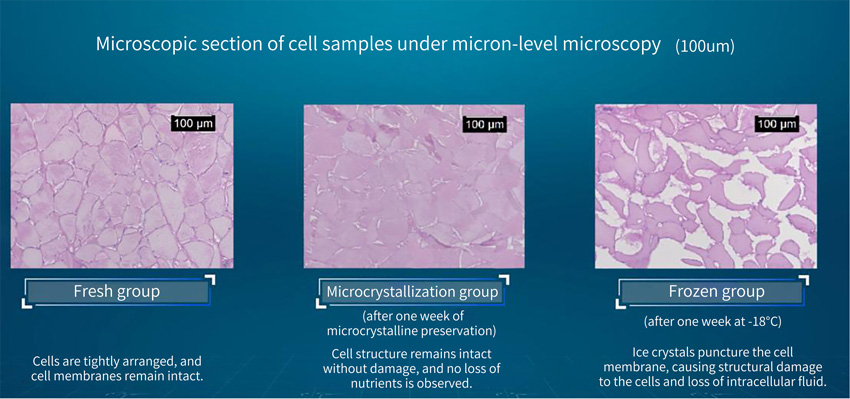
Food scientists have extensively studied frozen foods using optical and electron microscopy. At a microscopic scale of approximately **100 μm**, the differences between freezing methods become remarkably clear.
Microscopic observations reveal:
* Tightly packed cells
* Intact cell membranes
* Uniformly distributed micro ice crystals
* Minimal tissue deformation
* Well-preserved cellular architecture
In contrast, conventionally frozen samples typically exhibit:
* Extensive membrane rupture
* Large intracellular voids
* Collapsed tissue structures
* Visible traces of large ice crystals
* Significant moisture migration
These microscopic differences directly translate into the eating experience.
Every smooth bite, every burst of aroma, and every creamy texture enjoyed by consumers results from millions of healthy, intact cells working together to preserve the fruit's natural characteristics.
Understanding the relationship between ice crystal size and product quality is essential when selecting freezing equipment for commercial durian processing.
If your objective is to supply premium supermarkets, specialty retailers, or international export markets, a **liquid nitrogen blast freezer** is the preferred solution. Only ultra-fast freezing with microscopic ice crystal formation can consistently deliver the "fresh-like" quality demanded by premium consumers.
If maximizing product value is a priority, investing in liquid nitrogen freezing technology can significantly enhance market positioning. Conventional frozen durian often competes primarily on price in commodity markets. By contrast, durian frozen with liquid nitrogen technology can be marketed as **premium fresh-frozen durian**, allowing processors to achieve substantially higher pricing and stronger brand differentiation.
Consumer expectations continue to rise. Today's buyers increasingly value products that retain natural texture, aroma, and freshness. Manufacturers capable of consistently delivering superior quality are better positioned to build long-term customer loyalty and establish a sustainable competitive advantage. Liquid nitrogen blast freezing provides the technological foundation for that quality-focused strategy.
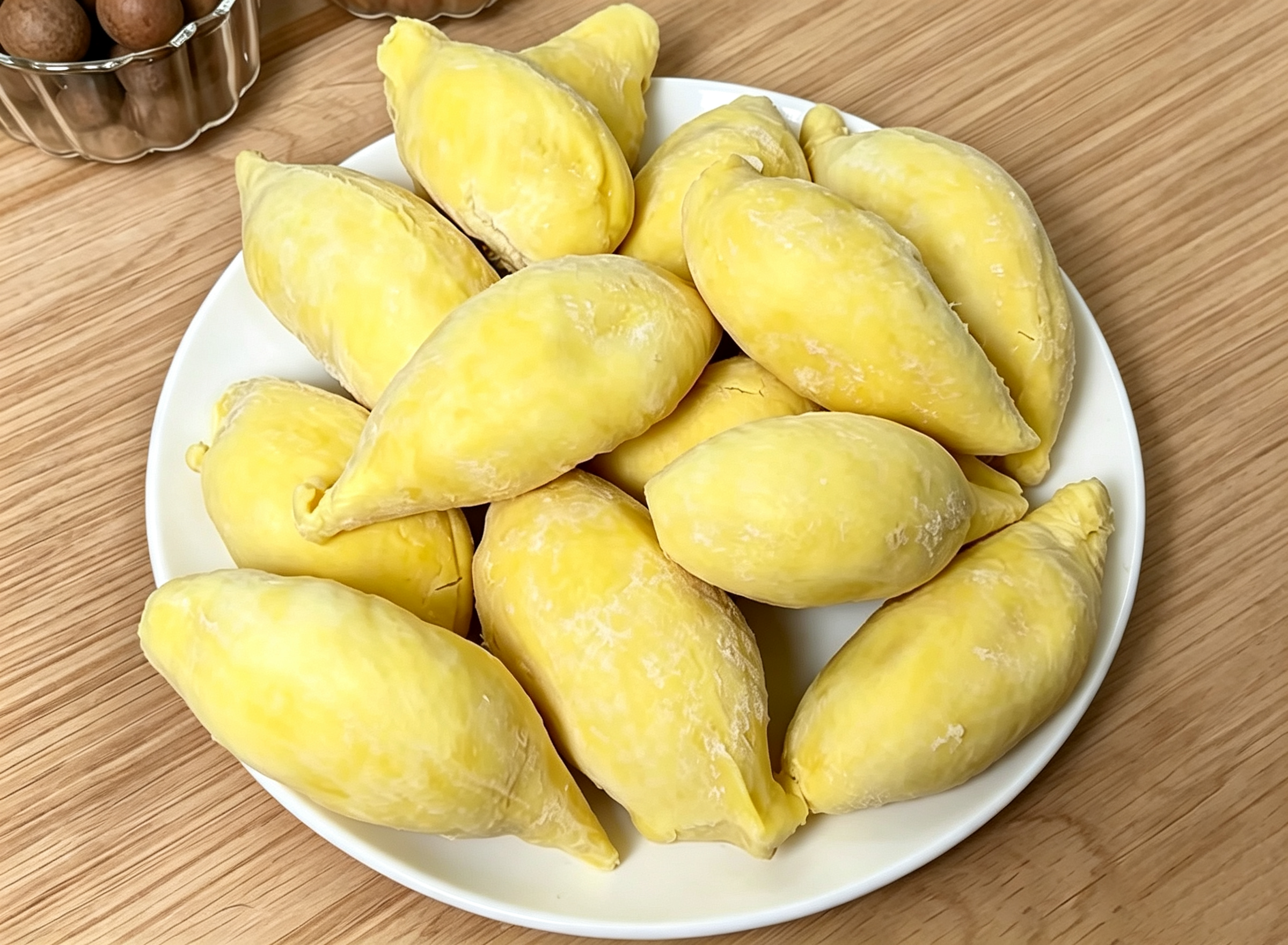
The difference between a **liquid nitrogen blast freezer** and a **conventional blast freezer** is ultimately a difference in **ice crystal science**.
Conventional freezing creates large ice crystals that damage cellular structures and compromise product quality. Liquid nitrogen freezing produces microscopic ice crystals that preserve cells, lock in moisture, maintain aroma, and protect the natural texture of durian.
Choosing a **liquid nitrogen blast freezer** means leveraging precise control at the microscopic level to achieve superior product quality at the marketplace level.
In the frozen durian industry, this revolution in ice crystal engineering is redefining the standard for premium frozen fruit—and creating new opportunities for processors seeking higher quality, stronger brands, and greater profitability.
