


If you have ever purchased durian pulp frozen in a traditional freezer, you must remember that disappointing scene: after taking it out and thawing it, a layer of cloudy liquid accumulates at the bottom of the package, the pulp becomes soft and watery, and the original rich creamy aroma is replaced by a faint “freezer odor.” This is what the industry commonly refers to as the “drip loss” phenomenon, and it has been a long-standing technical pain point in the field of durian freezing and processing.
However, the root cause of the drip problem is far more complex than it appears on the surface. It involves plant cell biology, thermodynamic mass transfer processes, and deep principles of food engineering. The emergence of liquid nitrogen freezer zero drip technology addresses this industry challenge at its root.
To understand why a liquid nitrogen freezer for durian can achieve “zero drip,” we must first understand why durian frozen in traditional freezers releases a large amount of liquid.
Durian pulp cells are filled with intracellular fluid, which contains dissolved sugars, organic acids, amino acids, vitamins, and volatile sulfur compounds that give durian its unique flavor. The cell membrane and cell wall together form a precise closed system, locking these valuable water and nutrients firmly inside the cells.
When durian is slowly frozen in a traditional freezer at around -35°C, the freezing process lasts for several hours. During this time, extracellular water freezes first, forming ice nuclei. Because the chemical potential of ice is lower than that of liquid water, the surrounding unfrozen water begins to migrate and accumulate toward these ice nuclei. As time passes, large and irregular ice crystals form outside the cells, while the water inside the cells is “drawn out” due to osmotic pressure differences to participate in the growth of these ice crystals.
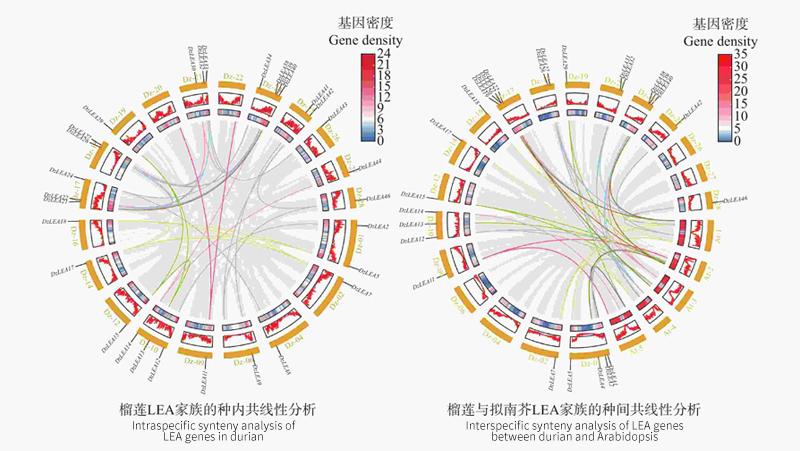
The image above shows a microscopic structural study of durian pulp, revealing the precise structure of the cell wall and cell membrane, which is exactly the core target that liquid nitrogen freezer technology aims to protect.
These large ice crystals expand in volume and generate enormous mechanical stress, directly puncturing the cell membrane and cell wall. When the durian is thawed, these damaged cells behave like leaking containers, no longer able to retain water internally, resulting in a large loss of intracellular fluid and forming the “drip loss” phenomenon we observe. More seriously, what is lost is not only water, but also dissolved sugars, flavor compounds, and nutrients.
Industry data shows that the dry matter loss of durian frozen in traditional freezers is as high as 3% to 5%, which means that for every ton of raw material, 30 to 50 kilograms of net weight is lost during the freezing process. For a high-value raw material like durian, this directly erodes the profit margin of enterprises.
The core mechanism by which a liquid nitrogen freezer zero drip system works lies in its ultra-fast freezing characteristics, which fundamentally change the way ice crystals form.
The working temperature of a liquid nitrogen freezer for durian reaches as low as -196°C. When durian pulp is placed into the freezer, liquid nitrogen is evenly sprayed through a nozzle system, and heat transfer occurs extremely rapidly. Within just 35 to 45 minutes, the pulp passes quickly through the maximum ice crystal formation zone (0°C to -5°C), leaving no sufficient time for water to migrate and accumulate. Instead, water nucleates rapidly in place, forming a large number of fine and uniform ice crystals that are evenly distributed inside the cells and in the intercellular spaces.
These tiny ice crystals have minimal volume expansion, and the mechanical stress they generate is not sufficient to damage the cell walls and membranes. The cellular structure remains intact, like countless micro-reservoirs, which can still firmly retain water during thawing.
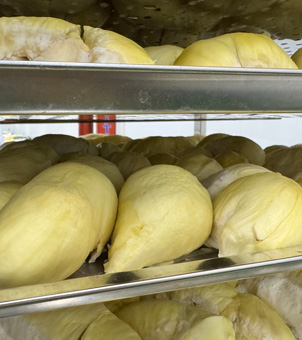
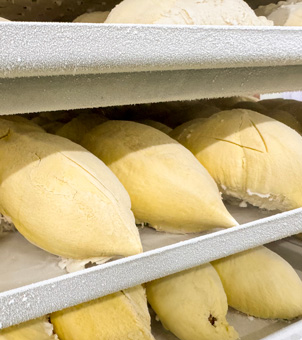
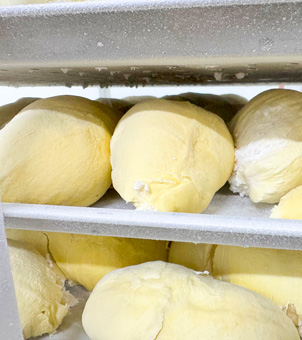
The image above shows the tray loading condition of durian pulp inside a liquid nitrogen freezer. The golden, plump pulp is neatly arranged on stainless steel trays, ready to undergo rapid freezing at -196°C.
Measured data shows that the dry matter loss of durian frozen using a liquid nitrogen freezer is less than 0.5%, and the raw material utilization rate is close to 100%. This means that enterprises not only avoid product quality deterioration but also significantly improve the economic output of raw materials.
To verify the zero drip performance of liquid nitrogen freezer technology, we conducted comparative tests in an actual production environment. The same batch of Monthong durian pulp was selected and processed using both a liquid nitrogen freezer and a traditional freezer, and then thawed under identical conditions (4°C refrigeration thawing for 12 hours).
Liquid Nitrogen Freezer Group Performance:
Traditional Freezer Group Performance:
This set of comparative data clearly proves that liquid nitrogen freezer zero drip technology can indeed achieve the long-sought goal of “no drip after thawing” in the industry.
In the durian processing industry, water retention rate is directly equivalent to profit margin. The high water retention characteristics brought by cell-level freshness preservation technology create multiple commercial values for enterprises:
Increased Yield:
An additional 30 to 50 kg of finished product is retained per ton of raw material. Based on the market price of Monthong durian pulp, this directly increases the output value by hundreds to thousands per ton.
Reduced Defect Rate:
No drip means the pulp will not become soft or collapse, significantly improving the qualified product rate and reducing returns and waste caused by substandard quality.
Premium Pricing Space:
Durian pulp with **no drip after thawing** can be positioned as a “fresh-frozen grade” product, entering high-end supermarkets and e-commerce platforms, with a selling price significantly higher than ordinary frozen products.
For durian processors who pursue high quality, liquid nitrogen freezer technology not only solves the technical pain point of drip loss but also opens the door to high-end markets. In today’s market, where consumers are increasingly focused on food quality, “durian no drip after thawing” has become the basic threshold for premium frozen durian, and a liquid nitrogen freezer for durian is the most effective path to achieving it.
