


Have you ever been frustrated by meat that leaks a pool of blood after thawing? Or strawberries that turn into a mushy mess after being frozen? The culprit behind these issues is always the same: ice crystals.
Today, in just 5 minutes, we'll help you understand a "black tech" that is revolutionizing the traditional cold chain—Liquid Nitrogen Flash Freezing. As a supplier of liquid nitrogen freezing equipment, we will unveil the mystery behind this technology and show you how it uses extreme -196℃ temperatures to hit the "pause button" on freshness.
The working principle of a liquid nitrogen freezer can be summed up in two words: Direct Heat Exchange.
The equipment uses a specialized spraying system to atomize liquid nitrogen, which is at -196℃ under normal pressure, directly onto the food. When the liquid nitrogen contacts the food, which is at a much higher temperature, it instantly vaporizes (phase change), violently absorbing heat. This heat exchange, driven by a temperature difference of over 200℃, allows the food to rapidly pass through the zone of maximum ice crystal formation in a very short time (usually a few minutes to twenty minutes), achieving deep freezing.
Simply put, it's like unleashing an "extreme cold storm" on every piece of food, giving heat no chance to linger.
What does -196℃ actually mean?
It's -196 times colder than the freezing point of water (0℃) and over 10 times colder than your home freezer at home (-18℃)! At this temperature, even the behavior of water changes dramatically.
If you dip a fresh rose into liquid nitrogen and take it out after a few seconds, a gentle tap will shatter it into pieces like glass. This "shock and awe" brought by such extreme cold is our secret weapon for locking in freshness.
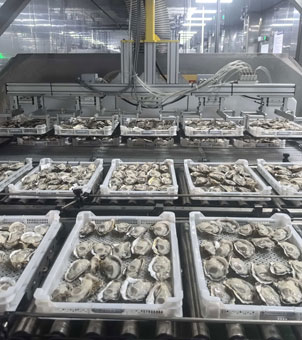
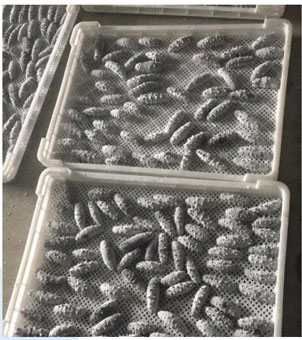
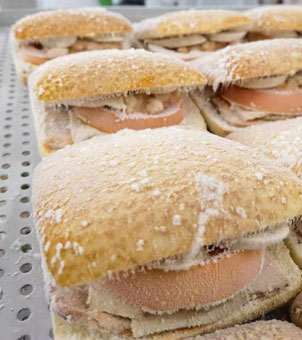
Think of traditional cold storage freezing as a "slow siege," while liquid nitrogen freezing is a "blitzkrieg."
Traditional freezing relies on cold air to slowly remove heat, making the process very slow (typically taking hours). Water outside the cells freezes first. Due to osmotic pressure, unfrozen water inside the cells is drawn out, forming larger and larger ice crystals that eventually puncture the cell walls.
Liquid nitrogen freezing, on the other hand, is a blitzkrieg. With a cooling rate of ≥50℃/min, it can lower the core temperature of the food to -18℃ in just minutes. It happens so fast that the water doesn't have time to "escape" and freezes right where it is.
| Comparison Aspect | Liquid Nitrogen Freezing | Traditional Cold Storage |
| Freezing Rate | Extremely Fast (minutes) | Slow (hours or even days) |
| Ice Crystal Form | Fine, uniform intracellular crystals | Large, irregular extracellular crystals |
| Cell Damage | Minimal to no damage, cell structure intact | Cell walls punctured, structure destroyed |
| Thawing Result | Minimal drip loss, returns to near-fresh state | Excessive drip loss, mushy, dry, and tough texture |
This relates to the physics of "ice crystal growth." When water freezes, the zone between 0℃ and -5℃ is the zone of maximum ice crystal formation. This is the "critical speed zone" that determines the final quality of the food.
Liquid nitrogen freezing uses its incredible speed to "race" through this dangerous zone. The water inside and outside the cells reaches its freezing point almost simultaneously, instantly forming countless microscopic ice crystals in situ, rather than one large ice lump.
Think of it like a sponge. Slow freezing would rupture its pores. Liquid nitrogen freezing is like the water in every tiny pore freezing into minuscule ice particles simultaneously. When thawed, the sponge's structure remains perfectly intact. This is the physical foundation of our ability to achieve "fresh-locking."
There is absolutely no need to worry about contamination.
First, liquid nitrogen itself is made by liquefying nitrogen, which makes up 78% of the air we breathe. It is a colorless, odorless, non-toxic, and chemically inert substance.
Second, in the freezer, the principle of contact is direct spray evaporation. The moment liquid nitrogen touches the food, it vaporizes into nitrogen gas. It does not permeate the food; it simply carries away the heat. When you open the equipment, all you see is white mist (which is actually water vapor in the air condensing). The food surface is clean and dry, with absolutely no residue.
Nitrogen gas itself is non-toxic, but it has one important characteristic: it can be asphyxiating.
Nitrogen makes up the majority of the air we breathe every moment. However, in a confined space, a large release of vaporized liquid nitrogen can "dilute" the oxygen concentration in the air (from the normal 21% down to below 18%), potentially leading to hypoxia.
This is why all properly designed liquid nitrogen freezers are equipped with powerful exhaust systems to ensure good ventilation in the workspace. As long as it's used according to safety guidelines in open or well-ventilated areas, it is completely safe for operators.
"Instant fresh-locking" might sound like a marketing term, but for liquid nitrogen freezing, it is a tangible physical reality.
The -196℃ ultra-low temperature of liquid nitrogen provides an immense "temperature difference driving force." This force drives heat exchange so rapidly that it physically alters the way water crystallizes—instead of forming destructive, large hexagonal ice crystals, it creates a "partially vitrified" state or micro-crystals.
This is equivalent to using a physical method to "freeze-frame" the original state of the ingredient (including its moisture, flavor, and nutrition) in that instant before its cell structure can be destroyed. Upon thawing, these preserved elements are released intact, naturally restoring the food's original freshness.
Liquid nitrogen flash freezing is more than just an equipment upgrade; it's a technological revolution rooted in "respect for ingredients." It uses extreme speed to combat the ravages of time.
If you are looking for a freezing solution that can truly enhance product quality and reduce waste, we invite you to learn more about Speedcryo's liquid nitrogen freezing equipment. Let's work together to protect every bit of freshness with black technology.
