


Durian, widely known as the “King of Fruits,” captivates global consumers with its rich aroma and creamy, custard-like texture. However, preserving durian at its peak quality has long been a major challenge in the food processing industry. Once harvested, durian has an extremely short optimal consumption window. For processors, the core question is clear: how to extend shelf life without compromising its unique sensory profile?
For years, conventional freezing methods have been applied in durian processing. Yet they suffer from a critical flaw—after thawing, the pulp often becomes watery, mushy, and significantly loses its signature aroma. The root cause lies in one fundamental factor: Ice Crystal Formation During Freezing.
To fully understand the advantages of a Liquid Nitrogen Freezer for Durian, it is essential to examine the concept of the maximum ice crystal formation zone (0°C to -5°C). This temperature range is where water transitions into ice, and the speed of this transition determines the size and structure of the ice crystals.
Traditional air-blast freezers typically operate between -18°C and -40°C, requiring 8 to 12 hours to freeze a batch of durian pulp. During this prolonged process, the product slowly passes through the critical ice formation zone. Water molecules have sufficient time to migrate and aggregate, forming large, irregular ice crystals. These crystals act like microscopic blades, rupturing cell membranes and damaging the cellular structure.
In contrast, -196°C Freezing Technology using liquid nitrogen fundamentally changes this process. When liquid nitrogen is sprayed evenly onto durian pulp through a specialized nozzle system, it rapidly absorbs heat through phase change. Combined with forced convection inside the freezer, the heat transfer efficiency is tens or even hundreds of times higher than conventional air cooling.
As a result, durian pulp passes through the critical temperature zone within minutes—typically completing the entire freezing process in just 35–45 minutes. Water molecules do not have time to migrate; instead, they form extremely fine and uniformly distributed ice crystals in situ.
These microcrystals do not damage cell membranes. The cellular integrity remains intact, which is why durian frozen in a liquid nitrogen freezer for durian can fully restore its original creamy texture after thawing. Moisture remains locked inside the cells, preserving both structure and mouthfeel.
Modern liquid nitrogen freezers adopt a cabinet-style design with food-grade stainless steel interiors and multi-layer tray systems. Operators load durian pulp onto stainless steel trays and place them into the freezer chamber.
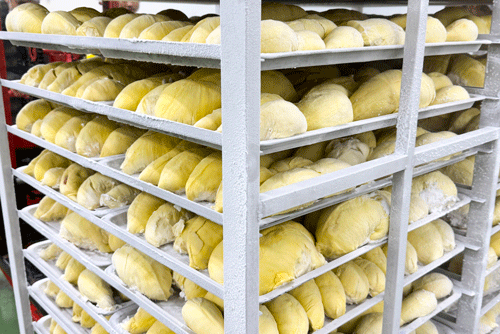
Once the system is activated, liquid nitrogen is sprayed from top and side nozzles, instantly creating an ultra-low temperature environment of -196°C. The entire batch freezing process is completed within 35–45 minutes—over 10 times faster than conventional freezing systems.
This batch-processing mode also offers exceptional flexibility. Producers can easily adjust production volumes based on order demand, making it ideal for both small-scale trials and large-scale seasonal processing during peak durian harvest periods.
For a premium fruit like durian, texture and aroma define product value. This is where durian freshness preservation technology based on liquid nitrogen demonstrates clear superiority:
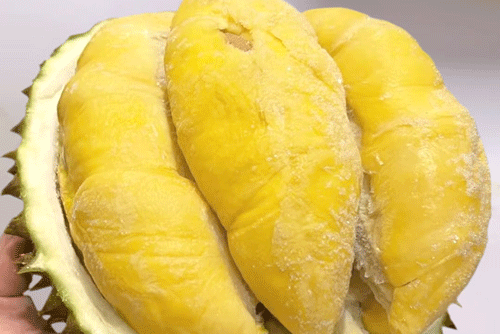
Texture Retention:
Because the cellular structure remains intact, thawed durian maintains nearly the same firmness and creaminess as fresh fruit. The smooth, buttery mouthfeel is preserved without the fibrous or grainy texture often seen in conventionally frozen products.
Aroma Preservation:
Durian’s characteristic aroma comes from complex volatile sulfur compounds. Rapid freezing at -196°C instantly seals the surface of the pulp, minimizing the loss of these volatile compounds. In contrast, traditional freezing methods expose the product to airflow for hours, causing significant aroma loss.
Adopting a Liquid Nitrogen Freezer for durian is not just a technical upgrade—it is a strategic shift in business positioning.
Products processed with -196°C Freezing Technology can be marketed as premium frozen durian or cell-preserved durian, targeting high-end consumer segments. Market data indicates that liquid nitrogen frozen durian can achieve a price premium of 15% to 30% compared to conventional frozen products—more than enough to offset the additional cost of liquid nitrogen.
For export markets such as Japan, South Korea, and the Middle East, this technology becomes a critical competitive advantage. Consumers in these regions demand near-fresh quality, which traditional freezing methods cannot deliver. In contrast, durian processed with advanced durian freshness preservation technology meets strict international standards in both taste and nutritional retention.
In an increasingly competitive durian industry, relying on price wars is no longer sustainable. The real opportunity lies in technological differentiation.
By leveraging Liquid Nitrogen Freezer for durian systems, processors can:
Ultimately, -196°C Freezing Technology is not just about freezing—it is about preserving the very essence of the “King of Fruits.”
