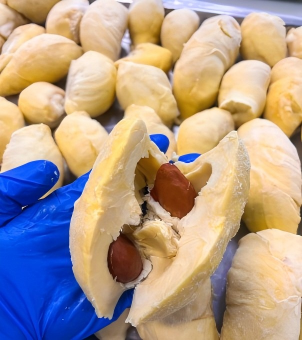
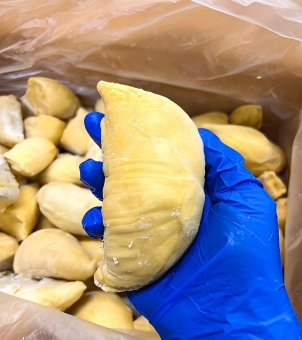
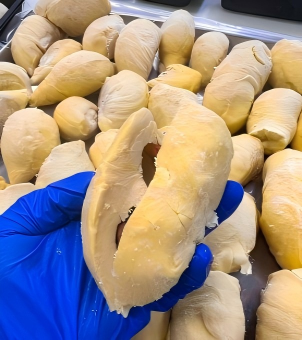
Durian is often called the "king of fruits," largely due to its unforgettable, pungent aroma. This fragrance is not a single substance but a complex blend of dozens of volatile sulfur compounds, esters, and aldehydes. Among these, volatile sulfur compounds are the core source of durian’s signature smell—and the most prone to loss during processing.
One of the biggest sensory flaws of traditionally frozen durian is the massive loss of aroma. Many consumers have experienced this: thawed durian from conventional freezers "doesn’t smell strong enough" and "doesn’t taste as rich," lacking the soul of fresh durian. What’s the science behind this? And how does liquid nitrogen freezer technology solve the problem?
The Chemistry of Durian’s Aroma: Why Is It So Fragile?
Scientific research shows that durian’s signature aroma comes mainly from these volatile compounds:
- Sulfur compounds (e.g., diethyl disulfide, dipropyl disulfide) – provide the characteristic "rotten" note.
- Esters (e.g., ethyl acetate, ethyl butyrate) – contribute fruity and sweet layers.
- Aldehydes and ketones – offer fresh top notes.
Most of these compounds are highly volatile with low boiling points. At room temperature, they constantly escape from the pulp surface—which is why a ripe durian fills an entire room with its smell. This high volatility is a double-edged sword: it gives durian its alluring aroma but also makes it extremely vulnerable to loss during processing and storage.
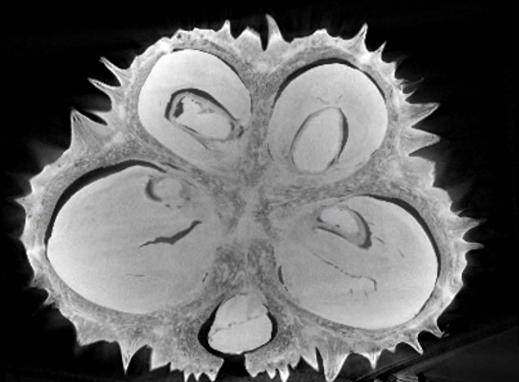
The X-ray image above shows the internal structure of durian, with clear distribution of flesh and seeds—the precious pulp tissue that carries the aroma.
The Aroma Killer: Time + Air Circulation in Traditional Blast Freezers
Traditional blast freezing takes 8 to 12 hours. During this process, two key factors cause massive aroma loss:
- Long exposure time: As the durian cools from room temperature (approx. 25°C) to target temperature over several hours, it lingers in the 0°C to 10°C range—exactly where volatile sulfur compounds are most active. This gives aroma compounds plenty of time to escape.
- Side effect of forced air circulation: Traditional blast freezers rely on powerful fans to circulate cold air, removing heat via forced convection. But this constant airflow acts like an "aroma vacuum," continuously pulling volatile compounds away from the pulp surface. Studies show that durian frozen by traditional blast freezers retains less than 60% of its original volatile sulfur compounds.
How Liquid Nitrogen Freezing Cabinets Lock in Aroma: Instant Sealing
Liquid nitrogen freezing technology excels at preserving aroma, thanks to its unique cabinet-based mechanism:
- Extreme speed, minimal escape window: Liquid nitrogen at -196°C, combined with a nozzle system that evenly sprays the cabinet interior, brings the durian pulp from room temperature to frozen in just 35 to 45 minutes. The time spent in the aroma-active 0–10°C range is drastically shortened, so volatile sulfur compounds don’t have time to escape and are "frozen" inside the pulp tissue.
- Instant surface sealing forms an aroma barrier: When liquid nitrogen contacts the durian pulp surface, surface moisture freezes instantly, forming a dense ice crystal film. This "ice seal" effectively blocks the diffusion of internal aroma compounds to the outside environment—like a transparent aroma protective suit.
- Enclosed cabinet environment avoids aroma suction: The liquid nitrogen freezer uses a closed box design. The nitrogen gas produced from liquid nitrogen evaporation fills the cabinet, creating an inert protective atmosphere. Compared to the open, strong-air-circulation of traditional freezers, this greatly reduces aroma loss.
Quantitative Comparison of Flavor Preservation
To scientifically assess aroma retention, we analyzed durian pulp under three conditions using gas chromatography-mass spectrometry (GC-MS):
- Fresh durian (control): 47 major volatile compounds detected; total peak area as 100% baseline.
- Liquid nitrogen frozen durian (after thawing): 45 major volatile compounds; total peak area at 92% of fresh.
- Traditional blast-frozen durian (after thawing): Only 38 major volatile compounds; total peak area at 54% of fresh.
The data clearly show that liquid nitrogen freezer technology preserves over 90% of volatile flavor compounds, while traditional blast freezing loses nearly half. Sensory evaluation makes the difference even clearer: durian frozen with liquid nitrogen cabinets is significantly superior in aroma intensity, complexity, and persistence.
Commercial Application: Aroma = Brand Identity
In the premium durian market, aroma is the core differentiator. Liquid nitrogen freezing technology gives businesses not just a better product, but a unique brand story:
- "90%+ aroma retention" – can be used as a core selling point, directly comparing with the fresh durian experience.
- "Aroma-locking technology" concept – package the liquid nitrogen cabinet as a proprietary aroma-locking process to enhance brand perception.
- Export market passport – High-end markets like Japan and South Korea have strict requirements for durian aroma retention; liquid nitrogen freezers are a reliable technical path to meet those standards.
For durian processors pursuing ultimate quality, liquid nitrogen freezer technology is not just a preservation method—it’s a core tool of flavor engineering. In an industry where aroma equals value, the technology that can fully seal the soul of the "king of fruits" is the most competitive commercial asset.