


The first time many people hear about liquid nitrogen flash freezing, the same question pops into their heads: “Can the food still taste good after being hit with -196℃ extreme cold?”
Will the steak become dry and tough? Will the crayfish meat fall apart? Will thawed strawberries turn into a puddle of red liquid? — These are valid concerns, because traditional freezing has left too many people with the psychological shadow of “thawing equals disaster.”
Today, we’ll walk you through specific ingredients and show you exactly what happens after liquid nitrogen freezing — steak, crayfish, strawberries, salmon, ice cream, and more.
Answer: Yes — it retains over 30% more juice than ordinary frozen steak.
The “juiciness” of steak comes from water and myoglobin within the muscle fibers. With traditional freezing, large ice crystals puncture cells, causing a lot of juice loss upon thawing — that’s the source of the “pool of blood” you see in the pan when frying.
Liquid nitrogen freezing is completely different: extremely fine ice crystals barely damage cell structures, so moisture stays locked inside the fibers. Measured comparisons:
One‑sentence conclusion: Liquid‑nitrogen frozen steak fries up more like “fresh meat” than “frozen meat.”
Answer: Yes — the smoothness improves by at least one grade.
Traditional ice cream makers rely on churning plus slow cooling. Ice crystals typically measure 30–50 microns, and your tongue can clearly feel a “sandy” or icy grit.
When making ice cream with liquid nitrogen, the liquid mix freezes in just seconds at -196℃. The ice crystals can be controlled to under 10 microns — well below the human tongue’s detection threshold (about 20 microns). The result is extreme smoothness and creaminess, similar to the product from top‑tier molecular gastronomy dessert shops.
Plus, less churning is needed, so less air is incorporated, giving a richer, denser texture. Many high‑end ice cream brands are already using this technology.
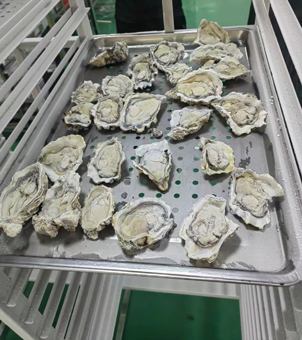
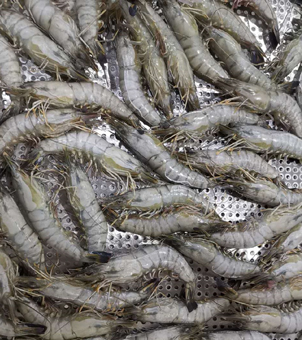
Answer: Not at all — the texture can approach sashimi‑grade quality.
What seafood fears most is thawing into a “tofu‑like mush” — the result of protein denaturation and muscle fiber breakage caused by traditional freezing.
With liquid nitrogen freezing, the cooling rate exceeds 50℃ per minute. The muscle fibers of salmon and shrimp are frozen before they have time to contract. After thawing:
Many Japanese restaurants and high‑end seafood suppliers have already replaced traditional boat freezing or land freezing with liquid nitrogen technology.
This is the most sensitive question for frozen fruit.
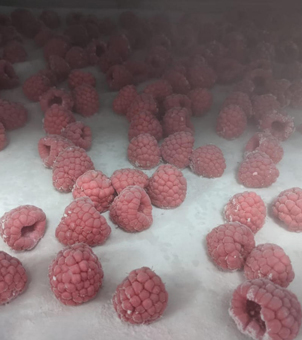
Conclusion: Thawed fruit cannot be 100% identical to fresh fruit (because even tiny ice crystals cause some physical change), but liquid nitrogen freezing is the technology that comes closest to “restoring fresh fruit.”
Answer: Yes — and they are far greener than with traditional freezing.
The green color of vegetables comes from chlorophyll. During slow freezing, chlorophyll easily degrades or oxidizes, turning vegetables yellow or gray. Liquid nitrogen freezing works so fast that it quickly inactivates enzymes like peroxidase, locking in the natural color.
Measured comparison:
The same applies to corn kernels. That’s why high‑end frozen vegetable brands choose liquid nitrogen freezing.
Answer: Very close — the surface doesn’t dry out or crack.
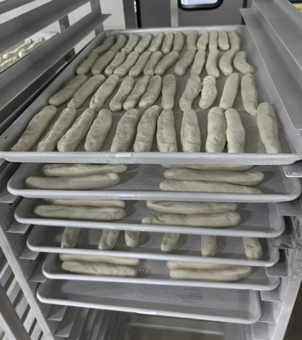
The biggest pain point for frozen dough products is that after reheating, the skin becomes dry, blistered, or even cracked. This happens because during traditional freezing, water redistributes in the dough and ice crystals destroy the gluten network.
With liquid nitrogen freezing, the center temperature of a bun drops below -18℃ within minutes. The gluten structure remains largely intact. After reheating:
Many chain breakfast shops and prepared‑meal factories have already replaced traditional air‑blast freezing with liquid nitrogen freezing.
Answer: Because the dumpling wrappers develop no micro‑cracks during freezing.
Dumplings usually break not because of poor cooking technique, but because they already have “hidden injuries” from freezing. During traditional freezing, water in the wrapper slowly freezes and expands, creating invisible micro‑cracks. When dropped into boiling water, thermal expansion instantly enlarges those cracks, and the filling leaks out.
With liquid nitrogen freezing, the wrapper and filling freeze almost simultaneously. There’s no uneven expansion, hence no micro‑cracks. The dumplings cook up intact, and the cooking water stays clear.
Real‑world data from restaurant chains: After switching to liquid nitrogen freezing, the dumpling breakage rate dropped from 5%–8% to below 1%.
Answer: They form a uniform, glass‑like block — no separation, no water weeping.
When broth is traditionally frozen, water freezes first. Salt, amino acids, colloids, and other components are “squeezed” into unfrozen zones. After thawing, this causes layering, sedimentation, and uneven flavor.
Liquid nitrogen freezing cools so fast that solutes cannot migrate. The entire liquid solidifies simultaneously, forming an amorphous, glass‑like state. After thawing:
This is extremely valuable for standardizing sauces in prepared meals and restaurant chains. Small‑portion frozen broth blocks can be dropped directly into a pot — convenient and stable.
Answer: No, it does not fully kill parasites. It can reduce risk but must be combined with other measures.
This is a very important food safety question. Liquid nitrogen freezing primarily stops biological activity through low temperature — it is not equivalent to sterilization or parasite killing.
Correct approach: Liquid nitrogen freezing plus subsequent heat cooking (core temperature ≥63℃) or proper deep‑freezing treatment (e.g., -35℃ for 15+ hours). For raw‑eaten salmon, always source from suppliers who have applied approved parasite‑control treatments.
Our advice: Liquid nitrogen freezing is a fresh‑locking technology, not a sterilization technology. Food safety cannot be replaced — always follow proper procedures.
| Ingredient Type | Pain Point of Traditional Freezing | Effect After Liquid Nitrogen Freezing |
| Steak | Lots of purge upon thawing, dry/tough texture | Juicy, fries up close to fresh meat |
| Ice cream | Obvious icy/sandy sensation | Ultra‑smooth, melts in the mouth |
| Salmon / Shrimp | Mushy, powdery, falls apart | Firm, bouncy, can be used for sashimi |
| Strawberries | Turns black, leaks liquid, soft/rotten | Keeps bright red color, shape intact |
| Peas / Corn | Dull color, poor taste | Bright green, crisp and sweet, vivid color |
| Steamed buns / Mantou | Reheated skin is dry and cracked | Smooth skin, close to freshly steamed |
| Dumplings | Break easily during boiling, filling leaks | Intact, no breakage, clear cooking water |
| Broth / Sauces | Separation, water weeping after thawing | Uniform glassy state, consistent flavor |
| Parasites | — | Not killed; requires cooking or proper deep‑freezing treatment |
Liquid nitrogen freezing is not magic. But with extreme physical speed, it solves the “ice crystal damage” problem that traditional freezing has struggled with for decades. Behind every improvement in ingredient quality is the victory of cell‑level protection.
If you are looking for a freezing solution that truly enhances product quality, reduces waste, and builds your brand’s reputation, welcome to learn more about Speedcryo liquid nitrogen freezing equipment. We are ready to provide you with real‑product testing, sample runs, and customized solutions.
